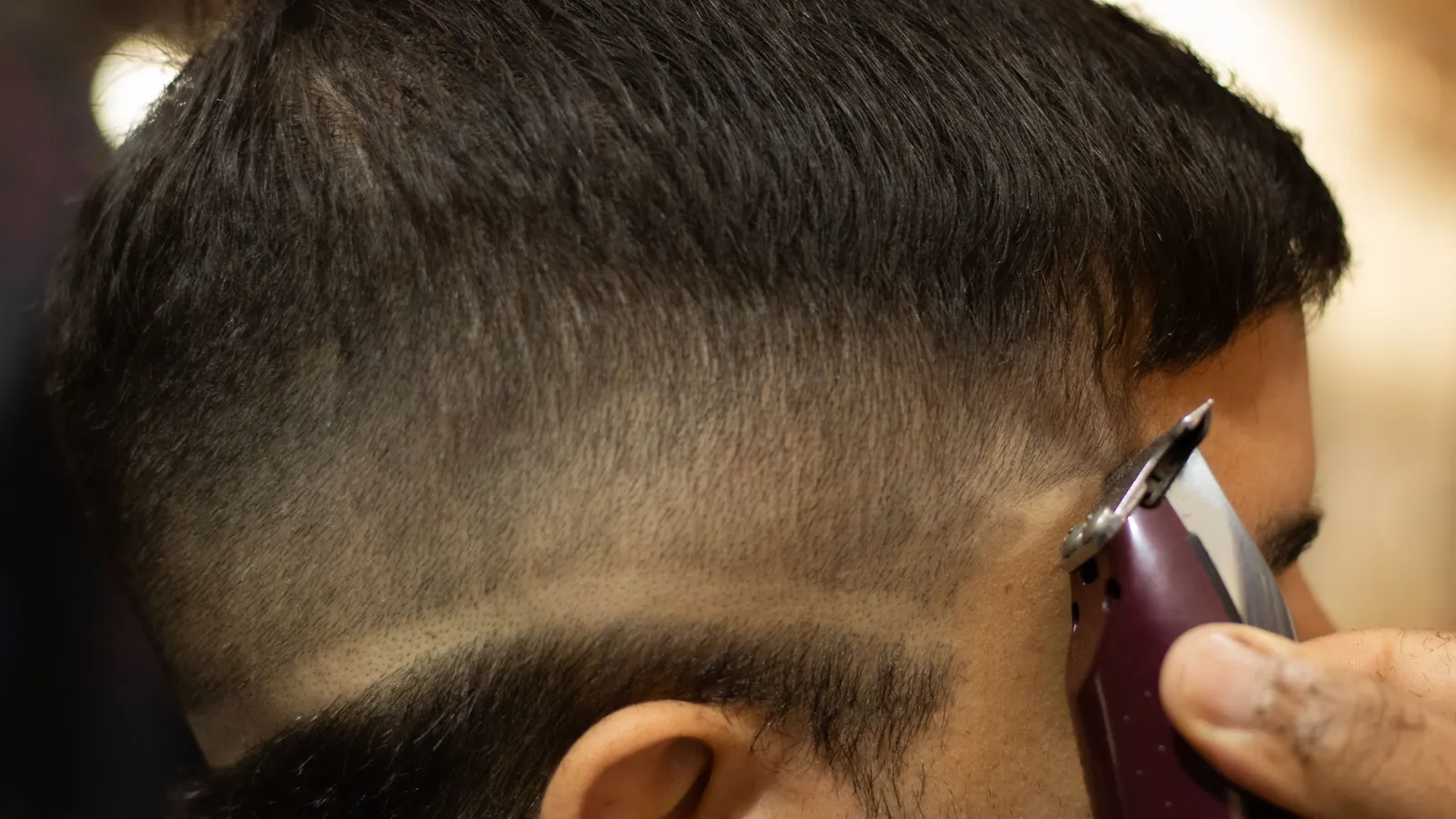
A taper shortens the hair gradually at the sideburns and neckline but usually leaves visible hair at the bottom. A fade blends the sides down to very short hair or bare skin, and it starts higher up the head. A taper grows out more gently; a fade looks sharper and needs a tidy every two to four weeks.
- Guard numbers: Wahl, BaByliss and Andis lengths from our clipper guard sizes chart (a number 1 leaves 3mm, a number 2 leaves 6mm).
- Prices and regrowth: from TheBarberBoard's own UK haircut price index and our styles guide.
- Barbers use the words loosely, so the safest way to ask is with guard numbers and where the cut should start. The table at the end gives the exact words.
Taper vs fade at a glance
Scroll the table sideways to see every column.
| Taper | Fade | |
|---|---|---|
| Where it's short | Sideburns and neckline only | Round the sides and back |
| Shortest point | Usually a short guard, hair still visible | Very short, often down to bare skin (a skin fade) |
| How high it goes | Low, just the edges of the hairline | Low (above the ear), mid or high (near the temple) |
| Look | Natural and tidy | Sharp, high-contrast |
| Grows out | Gently; fine for 4 to 6 weeks | Regrowth shows after about a week; tidy every 2 to 4 |
| Typical price | Close to a short back and sides | Skin fade £19 typical in towns, £22 in big cities |
Prices: typical skin fade from the TheBarberBoard UK haircut price index (price lists checked September 2026). Regrowth intervals from our men's haircut styles guide.
What is the difference between a taper and a fade?
The difference between a taper and a fade is how far up the head the short hair goes and how short it gets. A taper only shortens the very edges of the hairline, at the sideburns and the nape, and keeps some length there. A fade takes the whole side and back down through several guard lengths to very short hair or skin, so the blend is visible from across a room.
Both are a gradient from longer to shorter hair. The words overlap because many barbers call a short, low gradient a "taper fade". If you just say "taper" or "fade", expect the barber to ask a follow-up question.
Is a taper the same as a fade?
A taper is not the same as a fade, although both shorten the hair towards the neck. A taper stays mostly in the hairline and keeps hair visible at the bottom; a fade blends down further, often to skin, and starts higher. A low taper and a low fade can look similar from the side, which is why guard numbers are the clearest way to ask.
Which is better, a taper or a fade?
A taper is better for a cut that stays tidy for longer; a fade is better for a sharp finish if you can see a barber every two to four weeks. Neither is better in general:
- Choose a taper if you see the barber every 4 to 6 weeks, have longer hair on top, or want a classic side part.
- Choose a fade if you like a crisp contrast, wear a short crop or textured top, or keep the sides short anyway.
- Curly or Afro-textured hair: both work well. A taper keeps shape at the edges; a burst or drop fade is a popular way to frame curls on top.
What is a low taper fade?
A low taper fade is a short gradient that starts low, just above the ear and along the neckline, and blends down to very short hair at the edges. It sits between a classic taper and a low fade: more contrast than a taper, less skin on show than a fade. It's a popular choice with a textured top or a textured fringe.
Types of fade
- Low fade: starts just above the ear. The most subtle fade.
- Mid fade: starts about halfway up the side of the head.
- High fade: starts near the temple, so most of the side is very short.
- Skin fade (bald fade): taken right down to bare skin at the bottom. Our skin fade price guide covers what it costs in each part of the UK.
- Drop fade: the fade line curves down behind the ear instead of running straight round.
- Burst fade: short only in a half-circle around the ear, often with curly hair on top.
Taper vs fade in guard numbers
In guard numbers, a taper usually runs from the side length down to about a number 1 or 2 at the edges, while a fade runs down through several guards to a 0.5, no guard or the skin. A number 1 guard leaves 3mm and a number 0.5 leaves 1.5mm on Wahl and BaByliss, so the bottom of a taper still shows hair while the bottom of a fade shows scalp.
Scroll the table sideways to see every column.
| Cut | Sides | Bottom of the blend | What it looks like |
|---|---|---|---|
| Classic taper | Number 3 or 4 (10 to 13mm) | Number 2 (6mm) at the sideburns and nape | Natural, hair visible all round |
| Short taper | Number 2 (6mm) | Number 1 (3mm) at the edges | Tidy, scalp barely shows |
| Low fade | Number 2 or 3 | Number 0.5 (1.5mm) or no guard, just above the ear | Clean contrast low down |
| Mid or high skin fade | Number 2 to 4 on the upper sides | Bare skin, foil shaver or razor | Maximum contrast |
Typical combinations, not fixed rules: barbers vary the guards with hair thickness. Lengths from our guard sizes chart (Wahl, BaByliss and Andis from a number 1 up).
How to ask your barber for a taper or a fade
Ask with three facts: the guard on the sides, how short it goes at the bottom, and where the blend starts. For example:
- Taper: "A number 3 on the sides, tapered to a 1 at the sideburns and neck, keep it natural."
- Low fade: "Low fade from a 2, down to a half (0.5) just above the ear."
- Skin fade: "Mid skin fade, number 3 on top of the sides, down to skin."
A photo of the back and sides helps more than a name. Our guide to finding a good barber has more on what to say in the chair.
Does a taper or a fade cost more?
A skin fade usually costs more than a taper or a short back and sides, because it takes longer and needs more blending. In TheBarberBoard's UK haircut price index, a skin fade was typically £19 in towns and £22 in big cities, with independent London shops at about £26.50 (price lists checked September 2026). A taper is usually priced like a standard men's cut. Our haircut price guide has the full table.
Can you do a taper or fade at home?
A taper is the easier one to do at home, because it only covers the edges and doesn't need a perfect blend. A fade takes more practice, a clipper with a taper lever and good mirrors. Our step-by-step guide to fading your own hair covers the guard sequence, and the clipper guide lists clippers with a fade lever.