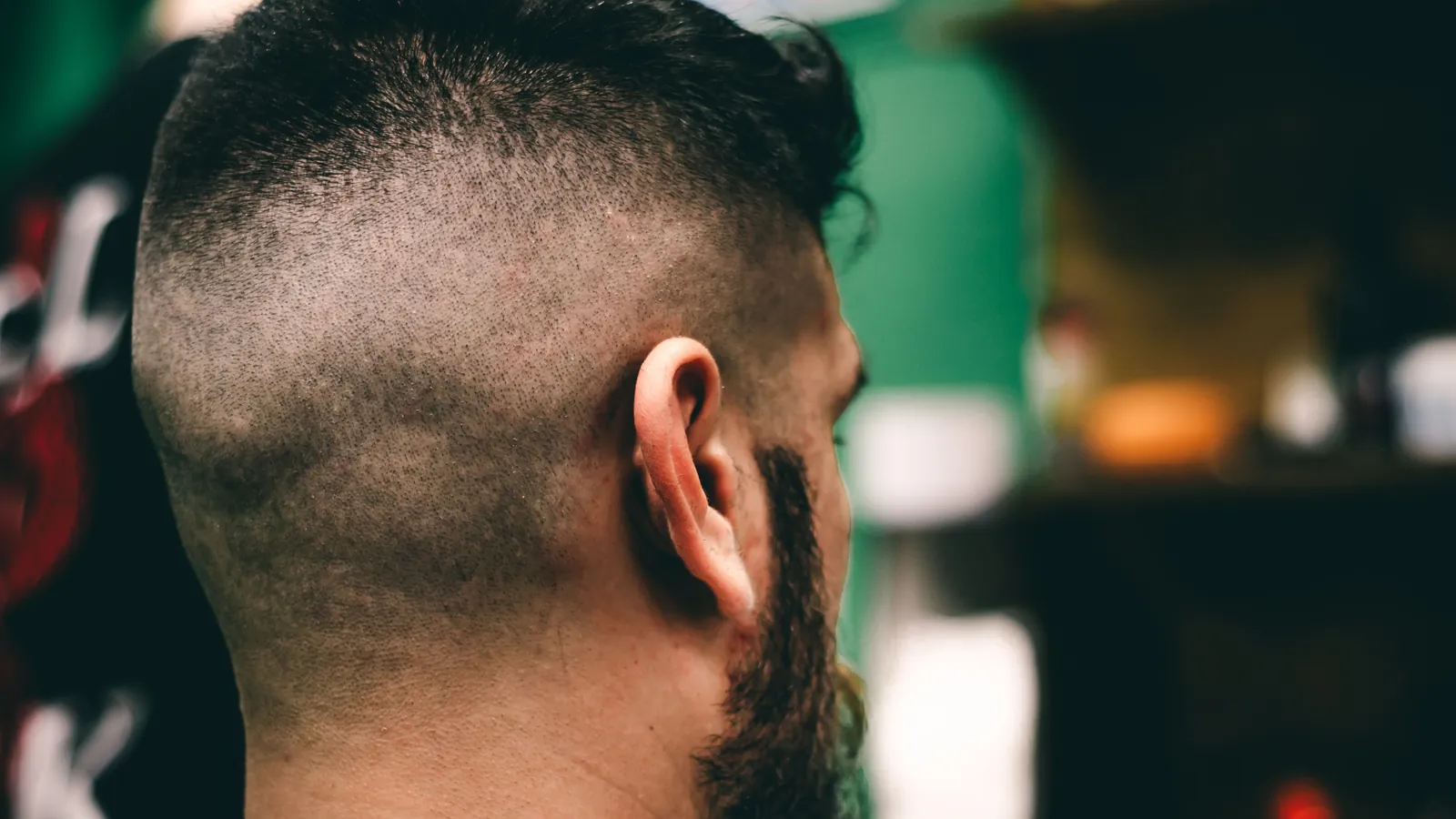
Most men's haircuts are a mix of two choices: how the sides are cut (short back and sides, taper or fade) and what the top does (crop, quiff, slick back, side part or buzz cut). Name both and a barber knows roughly what you want. Add clipper numbers and a photo and they know exactly.
What are the different types of men's haircuts?
The different types come from combining a side cut with a top style, so a "skin fade with a textured crop" or a "number 2 taper with a side part" tells a barber everything they need.
Style names drift from shop to shop, so the glossary below describes each one in plain English as well.
Sides: short back and sides
The sides and back are clippered to one even length, commonly a grade 1 to 4, and the top is left longer for scissor work. It's the default cut at most traditional UK barbers and the easiest to keep tidy.
Sides: taper
The hair gets gradually shorter towards the neck and ears but usually stays visible at the bottom. It's subtler than a fade and grows out more gently.
Sides: fade
The sides blend from longer hair down to very short or bare skin at the bottom. A low fade starts just above the ear, a high fade near the temple. Fades look sharp and need a tidy every two to four weeks.
Sides: skin fade (bald fade)
A fade taken right down to bare skin. It looks cleanest for the first week, then regrowth shows. Our skin fade price guide covers what it costs.
Sides: drop fade and burst fade
In a drop fade the fade line curves down behind the ear instead of running straight round. A burst fade is short only in a half-circle around the ear, and it's often paired with longer, curly or Afro-textured hair on top.
Top: crop and French crop
Short on top with the fringe pushed forward. A textured crop is cut with choppy edges and styled with fingers and a little matte clay, which suits hair that isn't poker straight. Both pair naturally with a fade.
Top: quiff and pompadour
A quiff is longer on top, swept up and back from the forehead, and needs clay or paste to hold. A pompadour has more height at the front and is usually finished shinier with pomade.
Top: slick back and side part
A slick back combs the top straight back, flat and smooth, and needs a few inches of length to lie down. A side part combs the hair across from a parting, sometimes with a shaved "hard part" line, and sits well with a taper.
Top: buzz cut, crew cut and Ivy League
A buzz cut is one clipper length all over. A crew cut leaves the top a little longer than the sides, and an Ivy League (or Princeton) leaves enough on top to part.
What are short haircuts for men called?
The common short haircuts for men are the buzz cut, crew cut, short back and sides, French crop, textured crop and Ivy League, usually with a fade or taper on the sides.
The quickest way to describe any of them is with clipper numbers: "a 2 on the sides, faded down to a 0.5, and a 4 on top" leaves no room for guessing. Our clipper guard sizes chart shows what each number leaves in millimetres.
What are the longer men's haircuts called?
Longer men's styles include the slick back, the pompadour, the modern mullet and the loose mid-length swept style, which keeps three to five inches on top pushed back or to one side.
Longer styles need scissor work rather than clippers on top, so check that a barber's photos show longer cuts before you book. The modern mullet keeps the sides and top short and leaves length at the back, often with a fade at the sides.
What is the most low maintenance haircut for men?
A buzz cut is the lowest-maintenance men's haircut: there is nothing to style, and you can redo it at home with a clipper and one guard.
If you'd rather not go that short, a short back and sides or a taper with a short scissor-cut top needs no product and still looks tidy after five or six weeks. Skin fades are the opposite: they look best for about a week and need a cut every two to three weeks.
| Style | Back in the chair every |
|---|---|
| Skin fade with a short top | 2 to 3 weeks |
| Fade (not to skin) with a short top | 3 to 4 weeks |
| Buzz cut | 2 to 3 weeks to stay sharp, or whenever you like |
| Taper or short back and sides | 4 to 6 weeks |
| Mid-length and longer styles | 6 to 10 weeks for a tidy |
Rough intervals. Our guide on how often to get a haircut goes into more detail by style.
What haircut should I get?
Choose the haircut you'll actually keep up: how often you'll visit a barber and how long you'll spend styling each morning rule out more styles than your face shape does.
- Visit every two or three weeks and want sharp lines: a fade with a crop or short quiff.
- Visit every five or six weeks: a taper or short back and sides.
- No product, no styling: a buzz cut, crew cut or French crop.
- Want to grow it: a longer taper, then a mid-length or slick-back style.
Whatever you choose, bring two or three photos from different angles, say what you don't want ("don't take it to skin"), and tell the barber when you plan to come back. They'll cut differently for a three-week look than a six-week one. If you're not sure which shop to use, see our guide to finding a good barber.