To fade your own hair, cut the sides and back with your longest guard, then work down through shorter guards in smaller bands, flicking the clipper out at the top of each band. Blend with the taper lever, finish with a half guard or no guard, and check the back in a second mirror. Start long and low: you can go shorter, not longer.
- Kit: a clipper with a taper lever and guards from 0.5 to at least 3, a hand mirror plus a wall mirror (or a three-way mirror), a comb, and a towel round your shoulders.
- Lengths: a number 0.5 leaves 1.5mm, a 1 leaves 3mm, a 1.5 about 4.5mm, a 2 leaves 6mm and a 3 leaves 10mm on Wahl and BaByliss. Our guard sizes chart has every number and brand.
- Hair: clean and completely dry, so the clipper cuts evenly.
Can you fade your own hair?
You can fade your own hair at home with a clipper, a set of guards and two mirrors, but the back of the head is the hard part because you can't see it directly. Most people get a decent low fade on the first few attempts and a clean skin fade only after practice. A low fade on longer guards is the forgiving way to learn.
Is giving yourself a fade hard?
Giving yourself a fade is harder than a one-length buzz cut, mainly because of the blend at the back. The sides are straightforward in a mirror. The back needs a second mirror and slow, short strokes. Expect the first one to take much longer than a barber's cut, and to need a tidy-up from a barber if a line goes wrong.
How to fade your own hair, step by step
This sequence gives a low fade from a number 3 down to a half guard. Swap the numbers for your own lengths; the method stays the same.
- Set the base length. With a number 3 guard (10mm), cut the whole side and back, going against the direction of growth. This is the length at the top of the fade.
- Mark the fade line. Decide where the fade starts: for a low fade, about a finger's width above the top of the ear, running round the back at the same height. With a number 2 guard (6mm), cut up to that line all round.
- Go one guard shorter, one band lower. With a number 1 guard (3mm), cut a band roughly half the height of the last one, starting at the hairline.
- Add the bottom. With a half guard (number 0.5, 1.5mm) or no guard with the lever open, cut a narrow band just at the hairline and round the ear.
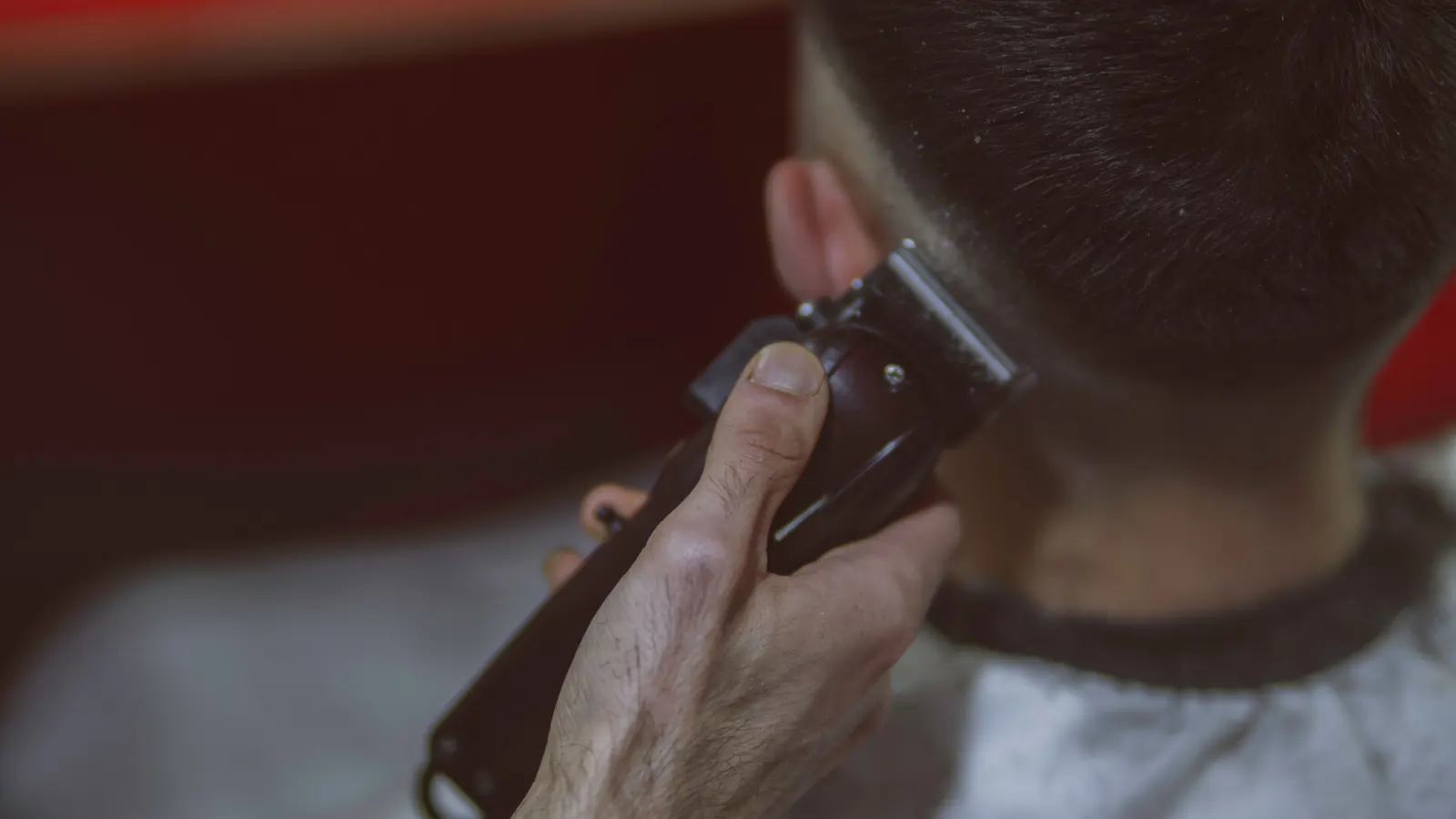
- Flick out at the top of each band. As the clipper reaches the top of each band, rock it away from the head in a scooping motion. This softens the step between guards instead of leaving a hard line.
- Blend with the lever. Go back over each line between guards with the longer guard and the lever half closed. On a Wahl clipper, closing the lever cuts slightly shorter and opening it cuts slightly longer; check your clipper's manual, as brands differ.
- Check the back. Hold the hand mirror behind your head, facing the wall mirror, and look for dark bands. Blend them with the next guard up and the lever.
- Finish the edges. Tidy the neckline and around the ears with a trimmer or the bare clipper blade.
How do you use the taper lever to blend?
A taper lever moves the clipper blade to change the cutting length by about a millimetre between fully open and fully closed, which fills the gap between two guard sizes. On a Wahl clipper the lever closed gives the shorter cut. Use it after each guard change: run the longer guard with the lever half closed over the line, then fully closed just above it. Our clipper guide lists the lever range for each model, such as 0.5 to 1.2mm on the Wahl Magic Clip.
Can you fade your own hair without a lever?
Without a taper lever, use half guards (1.5 and 0.5) to fill the steps, and rely more on the flick-out at the top of each band. Philips and Remington clippers that set lengths in millimetres make this easier, because you can step down 1mm at a time; the Remington Power-X5 includes a 1 to 5mm fade comb in 0.1mm steps.
How do you fade Afro-textured or curly hair?
Fading Afro-textured or tightly curled hair at home works best with a sharp, close-cutting clipper and slow passes, because tight curls hide steps less than straight hair hides them. Cut against the grain on dry hair, use the lever more than the guards for the final blend, and moisturise the skin afterwards to calm any irritation. Many barbers finish a skin fade on curly hair with a foil shaver for a smooth bottom.
What are the common mistakes when fading your own hair?
The common mistakes are starting too short, pushing the clipper straight up, and not checking the back of the head. Each one leaves a visible line that is hard to fix without going shorter.
- Starting too short. Going straight to a 0.5 high up leaves nothing to blend into. Start long and low.
- Pushing the clipper straight up. A straight push leaves a hard line at the top of each band. Flick out instead.
- Uneven fade lines. Check both sides against the top of the ear before going shorter.
- Skipping the back check. Most visible steps are behind the ears and at the crown.
- Cutting wet hair. It lies flat and cuts unevenly; dry hair shows the true length.
When should you go to a barber instead?
Go to a barber for a skin fade or a high fade before an important event, or to fix a fade that has gone wrong. A skin fade typically costs £19 in towns and £22 in big cities, according to TheBarberBoard's UK haircut price index (price lists checked September 2026). A good middle ground is a barber fade every few weeks, with home tidy-ups of the neckline and edges in between.